Rankin Island
Project
During an expedition with Aurora Expeditions in 2003 we had the
opportunity to visit a series of ephemeral pools on Rankin Island.
An aerial photo we had showed these pools as beautiful blue
splashes of colour in the usual harsh Kimberley landscape.
Upon arrival we
found an incredible scene of rock beach and hillside ridges
looking extremely symmetrical and no water.
In an attempt to
discover and photograph as much as possible we spread out and all
ran to agreed locations. One scout found a cave which has signs of
human habitation in the past and as we approached it we were
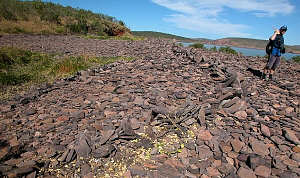
struck with an amazing 75cm high man-made ridge of stones on the
top of one beach ridge.
The stone
construction ran almost from the mouth of the cave for about 75m
along the top of the ridge, made a loop about 10x15m and nearby
were a series of 'pools'. All this was very reminiscent of
Aboriginal fish trap construction except for one very strange
feature - it was 2m above sea level!
Prof Peter Flood
(UNE) has shown that there have been several higher sea stands
over the last 5000 years. 2m higher 5000 years ago, 1.5m higher
3000 years ago and 80cm higher about 800 years ago.
So is this an
old, 5000 years old, fish trap? Or is it a ceremonial stone site?
Or is it something else?
Working with the traditional owners, the WA Museum (Dr Moya
Smith), Aurora Expeditions and the University of New England (Prof
Peter Flood) we have gained a permit to visit the site and collect
several specimens, if we can find any, for dating.
We need to ensure
that no damage is done to any aspect of the area and a 3m croc we
saw there keeps us well behaved! In addition we will map the site
and photograph it again to provide researchers with better tools
to assess it. This will lead to appropriate understanding and
management of the area.
In December
2004 at a meeting during the Australian Arhcaeology Association
Conference at the University of New England with Dr Peter Veth,
AIATSIS, Dr Sue OÇonnor, ANU, Prof Peter Flood and myself it was
decided that there was no point in trying to get any further
dates on the corals from the wall - the 4565 years (+ or - 40
years) indicates that the wall could be that old, or whoever
built it used a piece of coral that old.
As a result a small paper is in preparation and will be
published later in the year.
